
Why sustainable equipment matters, now more than ever
Adult social care in England is facing significant cost pressures. Between 2018 and 2038, total expenditure on formal community-based and residential care for older people is projected to rise by approximately 94%, from about £18.3 billion to £35.5 billion (*ref European Journal of Health Economics), a stark reflection of demographic change and increasing care needs.
These pressures aren’t abstract statistics; they directly shape the clinical and fiscal decisions Occupational Therapists make every day. As dependency levels rise and the prevalence of conditions like dementia (which carry the highest cost per person) increases, the choices we make about equipment provision have profound implications for both patient outcomes and system sustainability.
Sustainability as a clinical and financial strategy
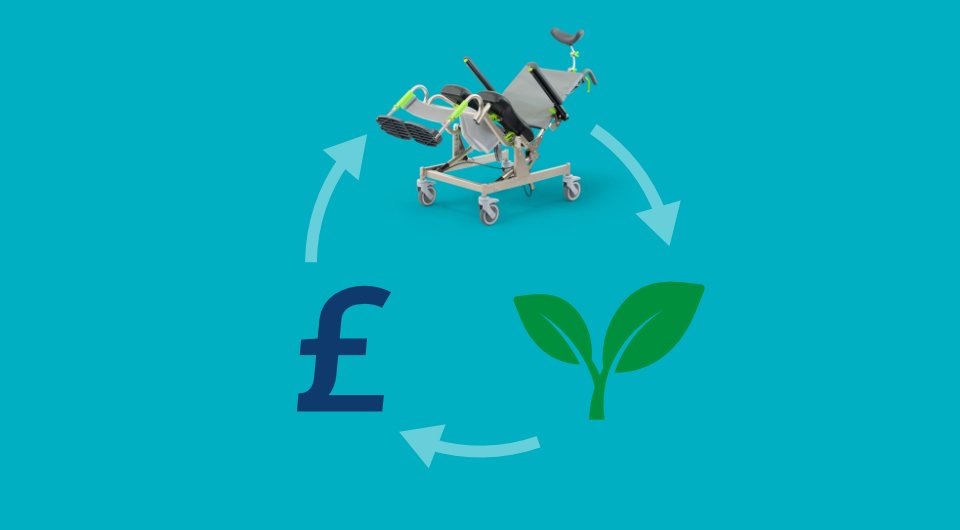
Sustainability isn’t only an environmental consideration; it’s a financial and clinical strategy by demonstrating how thoughtful design can support circular economy principles.
When equipment is repaired, reissued and ultimately recycled rather than discarded, disposal costs fall and service life is extended. Over time, this reduces pressure on procurement budgets, minimises waste management costs and supports more resilient community equipment provision, all while maintaining high clinical standards. Wider benchmarking across Community Equipment Store services is currently being explored to strengthen this evidence base.
Clinical reasoning: How chair design impacts care delivery
Shower chairs are more than seating; they are clinical tools. Models like RAZ and IndiGo² Shower Chair range incorporate features such as:
- Tilt-in-space functionality to support safe positioning
- Adjustability that aligns with individual biomechanics and functional ability
- Sturdy, ergonomic frames that support independence
These design elements reduce manual handling demands and enhance stability, which can enable safe personal care with one carer instead of two. From an OT standpoint, this reflects sound clinical reasoning: a well-matched intervention reduces risk, supports task performance, and minimises the intensity of carer input and eases financial pressures for families to pay for formal care.
A shift from double-handed to single-handed care during showering is not merely an efficiency gain, it is evidence of better alignment between the person, environment, and task that OTs strive for in practice.
Reframing cost: Lifetime value over upfront price
The temptation to prioritise upfront purchase price can obscure the true cost of equipment decisions. Lower-cost chairs may seem attractive initially, but often lack durability under high-use conditions, require earlier replacement and have limited adaptability as needs change.
Durable, adaptable models like RAZ and Indigo, by contrast, encourage longevity and reduce the need for repeated reassessment and re-prescription - freeing up OT time and reducing unnecessary expenditure.
For community equipment services, the ability to repair and reissue equipment extends service life and supports sustainable practice. In fact, data from one store network showed a 100% recyclability rate for the RAZ chair, highlighting how quality design can align with circular economy principles and cost-effective service delivery.
Sustainability as a strategic response to rising demand
Sustainability isn’t only an environmental consideration; it’s a financial and clinical strategy. With the projected growth in care needs and associated costs, durable, recyclable equipment is a practical lever for long-term system resilience.
By supporting safer, more efficient care processes and reducing reliance on excessive carer input, both formal and informal, sustainable shower chairs play a part in:
- Lowering handling and safety risks
- Reducing workforce pressures
- Strengthening clinical justification for equipment funding
- Supporting dignified care outcomes
What this means for practice
As adult social care costs rise and informal care demand grows, OTs are uniquely placed to influence meaningful change.
Simon Campbell, Managing Director at Wealden Rehab comments; “Choosing durable, adaptable shower equipment is more than an operational decision, it’s a strategic response to a combination of escalating care costs, workforce shortages, increasing dependency and complex needs and the need for value-based clinical practice.”
Future-proofing care begins with equipment choices that deliver lifetime value, support safer care, and contribute to sustainable pathways, for users, carers, and the system.
Contact our team for a full discussion or an assessment to help fulfil your care equipment solutions with sustainability and budgets in mind:
Call: 01634 813388
Email: sales@weladenrehab.com
Latest Blog Posts
Shower chair innovations solving complex care challenges
Prescribing care equipment is about finding solutions to complex human challenges.

Care for People, Care for Planet
Our sustainability approach... our brochure outlines our roadmap and strategy to net zero
Sustainable shower chairs for smarter budgets
Future-proofing care: Sustainable shower chairs for smarter budgets

Advancing safe, dignified bathing
A clinical perspective on the IndiGo² powered shower chair range
Seasonal opening times 2025/26
2025 Holiday Season Update - Our team are here for you but we will be taking a break between the 24th December and 2nd January 2025.

New Shower Chair Innovation
Experience Wealden Rehab’s new shower chair innovation at the OT Show 2025