



RAZ AT Shower Chair
Assessment
When Product Advisor Adam Webb first met with the local OT, client and his family, it was clear how challenging everyday care had become. Living with advanced Multiple Sclerosis, our client was fully dependent on others for all movement and personal care. Transfers were completed using a hoist, and even in supported sitting, he was unable to hold his head upright. This wasn’t just a matter of comfort, but a matter of safety. His head would fall forward, placing him at real risk of airway obstruction. Combined with swallowing difficulties that required regular suctioning, the risk of asphyxiation during routine care was a constant concern.
His posture added another layer of complexity. He leaned heavily to the right, making it difficult to position him safely, while a Category 3 pressure ulcer already compromised his skin integrity.
For his family and carers, something as routine as showering had become physically demanding and emotionally stressful. They were doing everything they could, but the equipment they had wasn’t enough.
Rather than looking for a quick fix, the focus was on truly understanding what this client needed to be safe, comfortable, and properly supported.
Working closely with the Occupational Therapist, we explored options that could address not just one issue, but the whole picture: posture, pressure care, and airway safety.
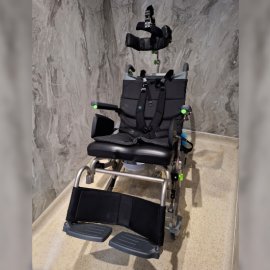
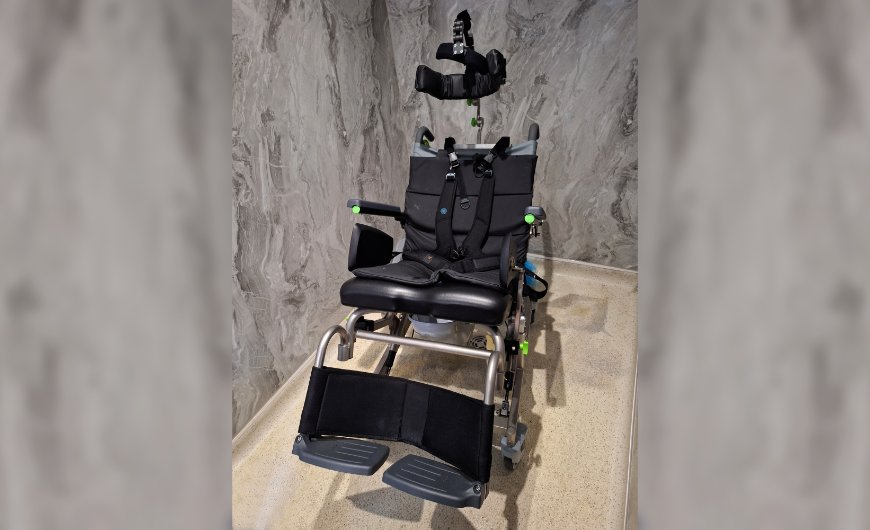
Together, we identified a specialist RAZ AT shower chair that could be carefully configured to meet his needs. It wasn’t just about the chair itself, but how it was set up around him, adding:
- G Headrest
- Visco foam Seating and seat cushion
- Shoulder harness
- Lateral Belt
- Leg Adductors
- Calf Strap
- 2-point hip belt
The Solution
The difference was immediate. For the first time, our client's head could be supported securely in a safe, upright position. The added head support and frontal stabilisation meant carers no longer had to physically hold his head during washing, removing a major risk and a huge source of stress.
The chair’s ability to gently tilt meant he could be repositioned without compromising his airway, allowing care to be delivered more safely and with greater control. His posture improved too; the lateral supports helped bring him into a more balanced position, reducing the strain caused by his strong lean to the right. Instead of constantly slipping or collapsing in the chair, he was now stable and well-supported.
Just as importantly, the pressure-relieving cushion made a real difference in protecting his skin. With an existing pressure ulcer, this was a crucial step in preventing further damage.
The Outcome
What stood out most wasn’t just the clinical improvements; it was the change in how care felt. For his family and carers, showering became safer and more manageable. The physical strain was reduced, and the constant worry about his airway eased. They could focus less on “holding him together” and more on simply caring for him.
The Result
This case is a reminder that the right equipment, thoughtfully chosen and carefully set up, can transform everyday experiences.
By taking the time to understand the full complexity of his needs and working collaboratively to find the right solution, we were able to turn a high-risk situation into one that feels safe, manageable, and respectful.
Sometimes, it’s not just about meeting needs. It’s about giving people and those who care for them the confidence that those needs are truly understood and supported.